
Table of Contents
- Start With the Recipient, Not the Words
- How to Start a Heartfelt Card: Openers That Don't Sound Generic
- Heartfelt Card Writing Templates You Can Adapt in Five Minutes
- Examples of Heartfelt Card Messages for Every Occasion
- Best Practices for Handwritten Notes: Pen, Paper, and Pacing
- Etiquette for Difficult Cards: Sympathy, Illness, and Apology
- Closing Lines and Sign-Offs That Land
- Frequently Asked Questions
Last Updated: October 2, 2026
Start With the Recipient, Not the Words
Most people stare at a blank card because they start in the wrong place. They hunt for the perfect words before they've thought about the person who will read them. Flip that order and the words come faster.
Heartfelt cards are short written messages that put genuine feeling for one specific person ahead of polished language. The goal isn't poetry. It's connection.
That's the approach we take at VEDA & LILY CO., where every gift ships with a pre-written message card for exactly this reason. People know what they feel. They just freeze when it's time to write it down.

So before you pick up a pen, answer one question: who is this for, and what do you actually want them to know?
The One-Detail Rule That Kills Writer's Block
Name one real detail about the person. Just one.
Not "you're amazing." Something only the two of you would know. The coffee they always order. The way they laughed at the airport. The recipe they handed down.
That single detail does two things. It proves you see them as an individual, and it gives your message a natural place to start.
Generic cards fail because they could go to anyone.
How to Start a Heartfelt Card: Openers That Don't Sound Generic
The best opening line names the person and the moment. Skip "I hope this finds you well" and start where the feeling is.
Try these approaches:
- Name the occasion: "Ten years ago today, you became my sister."
- Name the feeling: "I've been trying to find words for how proud I am of you."
- Name the memory: "I still think about that road trip and the terrible playlist."
- Name the truth: "I don't say this enough, so I'm writing it down."
Heartfelt Card Writing Templates You Can Adapt in Five Minutes
A template isn't cheating. It's a frame that holds your real feelings in place. These heartfelt card writing templates give you the structure so you can focus on the words that are yours.
The Gratitude Template
[Name], I've been meaning to tell you this. Thank you for [specific thing they did]. It mattered more than you know because [the effect it had on you]. I'm grateful you're in my life.
The Sympathy and Memorial Template
[Name], I was so sorry to hear about [loss]. I keep thinking about [a warm memory of the person]. They meant a lot to me too. I'm here for you, whenever you need, for whatever you need.
Keep this one short. Presence matters more than paragraphs.
The Milestone Template
[Name], watching you reach [milestone] has been one of the best parts of my year. I remember when [earlier moment], and look at you now. I can't wait to see what's next.
Examples of Heartfelt Card Messages for Every Occasion
Here are examples of heartfelt card messages you can borrow from directly. Swap in your own details and they'll read as yours.
Best Practices for Handwritten Notes: Pen, Paper, and Pacing
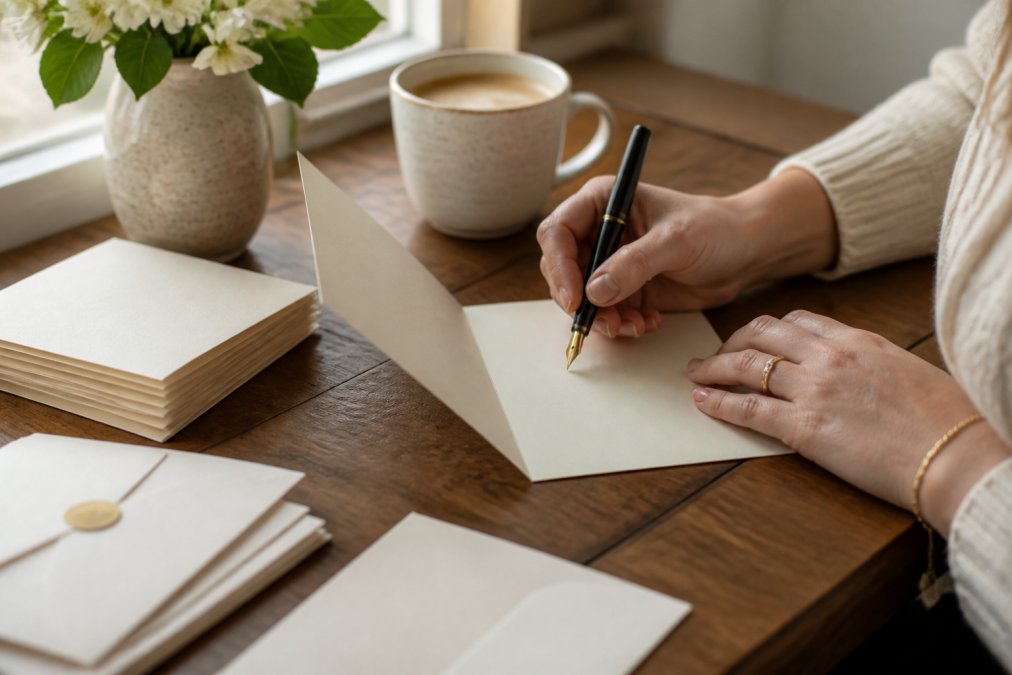
A few more habits that help:
- Write a rough draft on scratch paper first
- Leave the inside blank until you know your ending
- Sign with your full name if the recipient might not recognize your handwriting
- Keep it under 100 words for most occasions
Etiquette for Difficult Cards: Sympathy, Illness, and Apology
Hard cards follow one rule: lead with the other person, not yourself. Say the simple true thing and stop.
TO MY DAUGHTER PROUD LEATHER JOURNAL →
Sympathy Cards
Acknowledge the loss directly. Name the person who died if you knew them. Avoid "at least" statements, "at least she lived a long life," "at least he's not suffering", because they minimize grief and tell the mourner how to feel. Don't offer advice unless asked. Don't compare their loss to your own.
What works:
- "I'm so sorry about [name]. I'm thinking of you every day."
- "I don't have the right words. I just want you to know I'm here."
- "[Name] meant so much to me. I'll never forget [specific memory]."
Illness and Hospital Cards
Focus on the person, not the diagnosis. "I'm thinking of you" beats a list of remedies. Don't ask for a medical update in the card, that puts the burden on them to respond. Don't promise more than you can deliver ("I'll visit every week") unless you mean it.
What works:
- "No need to reply. Just wanted you to know I'm thinking of you."
- "I'm bringing dinner Thursday. Leave the porch light on if that works."
- "Rest up. The world can wait."
Apology Cards
Name what you did, own it, and skip the excuses. "I was wrong, and I'm sorry" carries more weight than a paragraph of explanation. Don't use the card to relitigate the argument. Don't ask for forgiveness in the same breath, give them room to decide.
What works:
- "I was wrong about [specific thing]. I'm sorry, and I'm not going to make excuses."
- "I've been thinking about what I said. It wasn't fair to you."
The Cards Nobody Talks About: Estrangement and Boundaries
Most guides skip the hardest situations. Here's how to handle them.
Writing a long, emotional message on a get-well or sympathy card can overwhelm the reader. Keep difficult cards brief. A short, sincere note respects their energy when they have little to spare.
Closing Lines and Sign-Offs That Land
Your sign-off should echo the feeling of the card, not just end it. Match the warmth of your message with a closing that fits.
Good options by tone:
- Warm and simple: "With love," "Thinking of you," "Always,"
- Grateful: "Thank you, truly," "With so much appreciation,"
- Supportive: "Here for you," "In your corner,"
- Playful: "Yours in chaos," "Love you, weirdo,"
- Formal but sincere: "With warm regards," "Sincerely, and with thanks,"
The Sign-Off Mistake Most People Make
The most common sign-off error is a mismatch of tone. A playful "Yours in chaos" on a sympathy card reads as tone-deaf, and a stiff "Sincerely" on a note to your best friend reads as cold. Read your opening line and your closing line back to back. If they don't belong in the same card, change one of them.
Adding a Date: A Two-Second Habit With Long-Term Payoff
Date the card in the corner, month, day, and year. It takes two seconds and turns the note into a keepsake the recipient can return to years later. A card with a date becomes a document. A card without one becomes a vague memory.
How to Store and Display Cards You Receive
Most people shove cards in a drawer and forget them. A little structure turns that pile into something worth keeping.
- Keep a dedicated box. A simple archival box or even a shoebox works. Label it by year so you can find things later.
- Store flat, out of sunlight. Direct sun fades ink and yellows paper faster than anything else. A closet shelf beats a windowsill.
- Avoid plastic bags for long-term storage. Ordinary plastic can trap moisture and off-gas over time. Acid-free sleeves or plain paper envelopes are safer for cards you plan to keep for decades.
- Display the current ones. A clipboard, a bulletin board, or a small frame on a desk keeps recent cards visible without damaging them.
- Photograph the ones that matter most. A phone photo takes seconds and preserves the message even if the paper is lost, damaged, or thrown out in a move.
A dated, signed card is a small piece of history. Treat it like one when you write it, and treat it like one when you keep it.
Frequently Asked Questions
How do you start a heartfelt card without sounding generic?
Open with the person, not the occasion. Name one specific thing about them or a shared memory before you say anything about the event. Instead of "Happy birthday," try "I still think about the night we drove home in that storm and you kept me laughing the whole way." One concrete detail signals that the card was written for this person and no one else, which is what makes heartfelt cards feel sincere rather than copied.
What are some heartfelt card messages I can write instead of 'love'?
Swap the single word for the reason behind it. Try "I'm grateful you're in my life," "You made a hard year easier," or "Watching you handle this has taught me something." Other options: "I keep bragging about you," "Thank you for showing up when it mattered," or "You are one of the few people I can be honest with." Each one says more than "love" because it explains what you appreciate and gives the recipient something specific to hold onto.
How do you end a heartfelt card meaningfully?
Match the sign-off to the relationship and the occasion. For a partner, "With all my love" or "Always yours" works; for a parent, "With gratitude" or "Thank you for everything"; for a friend, "Here for you, always." For sympathy cards, close plainly with "Thinking of you" or "With love and prayers" and skip cheerier phrasing. Then add your name and the date. Signing in ink rather than printing your name makes the ending feel like a hand extended, not a form completed.
What should I write in a sympathy card when I don't know what to say?
Keep it short, name the person who died, and offer one concrete memory or one specific offer of help. "I'm so sorry about your mom. She always made room for me at her table, and I'll never forget it. I can bring dinner Thursday if that helps." Avoid "at least," "everything happens for a reason," and long stories about your own losses. If you never met the deceased, say so honestly and focus on your care for the recipient instead.